


LED Bridge Lighting —
Engineering Specifications,
IP Ratings and System Design
Why Bridge Lighting Is Different
Most outdoor architectural lighting is specified for facades — sheltered from direct water impact, mounted at accessible heights, connected to building power distribution. Bridge lighting operates differently across every one of these parameters.
Bridge fixtures are installed directly in the path of road spray from fast-moving vehicles. They may be submerged during flood events. Maintenance access for replacement is expensive and sometimes requires lane closures or specialist equipment. Power distribution runs hundreds of metres, introducing voltage drop and surge exposure risks that simple building installations do not face. The specification must account for all of these conditions at the outset.
IP Rating — The Minimum for Bridge Installation
IP67 provides full dust protection and water immersion resistance to 1 metre for 30 minutes — sufficient for bridge deck fascias, parapet lighting, soffit installations and arch lighting that may experience road spray and temporary flooding. The rating assumes that gaskets and seals maintain their performance over a 5-year service period. JGJ/T 163-2008 (Urban Nightscape Lighting Design Standard) requires a minimum of IP54 for outdoor luminaires as a regulatory baseline; IP67 exceeds this for bridge-specific exposure conditions including road spray, thermal cycling and occasional flood-level water contact. For bridges where glare control is critical — such as road-facing barrier lights — structural (non-potting) waterproofing is preferable to glue-fill encapsulation, which degrades under UV and thermal cycling and progressively reduces optical output as the fill discolours and admits moisture.
On coastal or estuarine bridges, IP67 addresses water ingress but not the more significant risk of salt air corrosion. For coastal bridge lighting, specify marine-grade surface treatment on aluminium housings, stainless steel fasteners, and verify that the fixture manufacturer tests for corrosion resistance under IEC 60068-2-52 salt mist standard.
Cold-Climate Requirements
For bridges in Russia, Central Asia, Canada, Scandinavia and northern China where winter temperatures regularly fall below −20°C:
- Ambient temperature rating of −40°C minimum — this is a driver and LED specification, not just a housing rating
- Cold start capability — the driver must power on and reach full output immediately at −40°C without a warm-up period
- Thermal cycling test — fixtures should be validated through multiple cycles from −40°C to +60°C, as thermal expansion and contraction are a primary cause of seal failure over time
- Cable and connector ratings — all cables and connectors must be rated for −40°C operation; standard PVC cable becomes brittle below −15°C
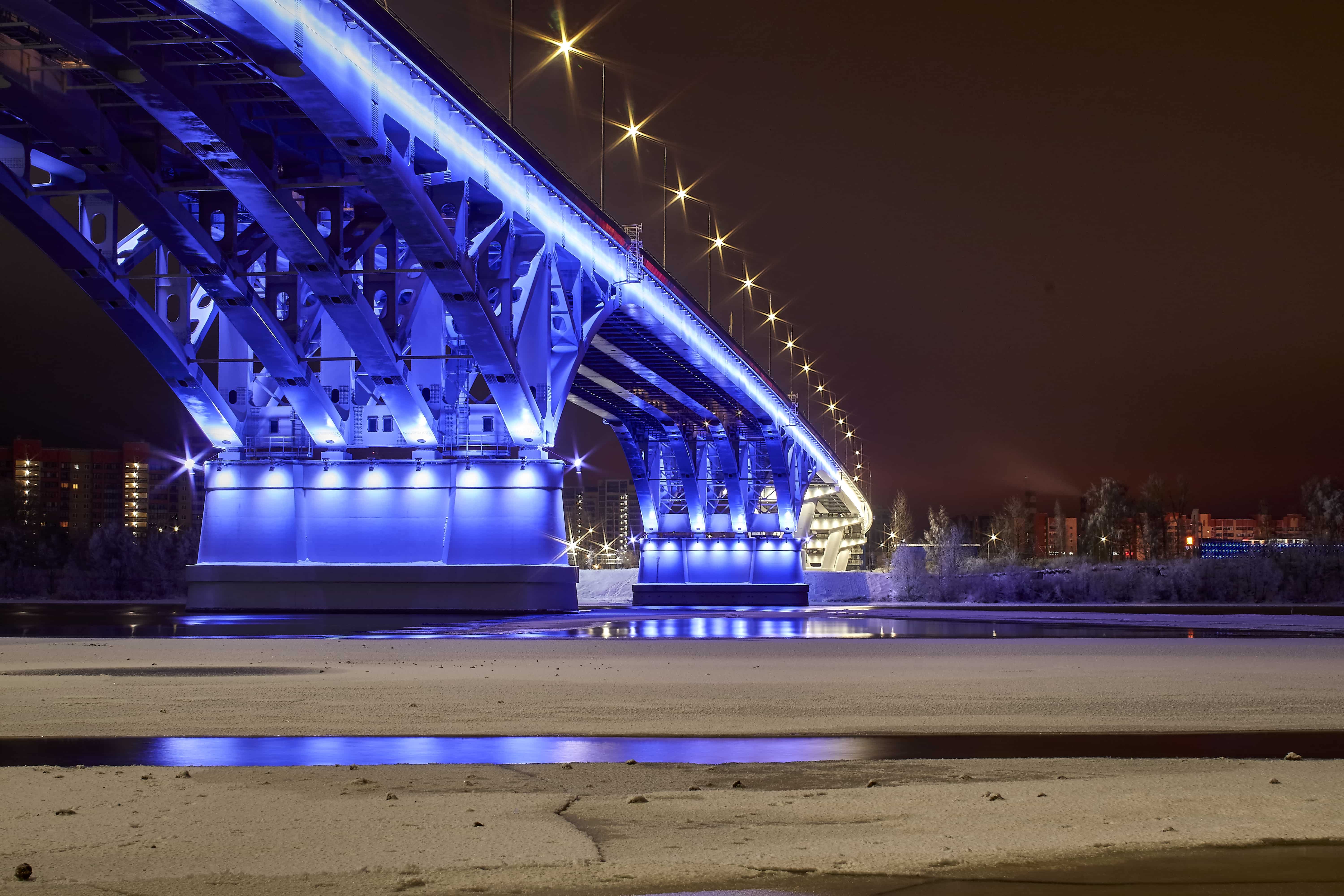
TPK's bridge-specified wall washers and linear lights have been field-validated to −40°C in Russian bridge installations. The Volgograd Bridge project on the Volga River has operated continuously through multiple severe Russian winters since installation. For bridges in temperate climates where cold start is not required, the minimum ambient rating of −20°C still applies to driver selection — a driver housing rated for outdoor use does not imply a −20°C start capability unless explicitly stated on the datasheet.
Control Protocol — DMX512 vs 0-10V for Bridges
For dynamic colour bridges, DMX512 is the only practical choice. It supports hundreds of independently addressed fixtures across long cable runs (with signal amplifiers every 300 metres), is compatible with all professional lighting control systems, and allows precise per-fixture colour programming for dynamic shows.
For bridges requiring only on/off switching and simple white dimming, 0-10V analogue control is simpler, lower cost, and does not require programming expertise. 0-10V is the appropriate choice for highway bridges, industrial crossings and any bridge where dynamic colour is not part of the brief.
| Control Method | Best For | Max Cable Run | Max Devices | Colour Capable |
|---|---|---|---|---|
| DMX512 | Dynamic colour bridges · City landmarks | 300m (amplified) | 512 per universe | Yes (RGBW) |
| 0-10V | Simple dimming · Highway bridges | ~100m | Circuit dependent | No |
| DALI | Small installations | ~300m | 64 per segment | Limited |
| Static (no control) | Fixed output bridges · Lowest cost | N/A | Unlimited | No |
Fixture Selection — Wall Washer vs Linear Light vs Spotlight
Wall Washers — for Bridge Fascias and Deck Undersides
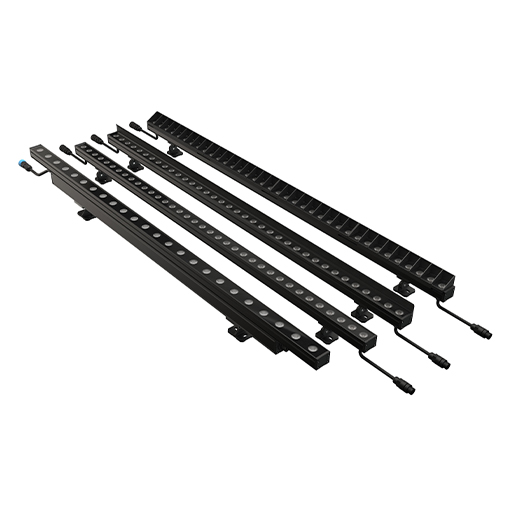
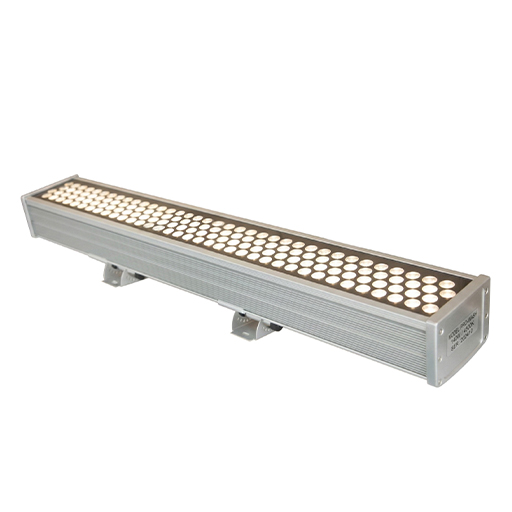
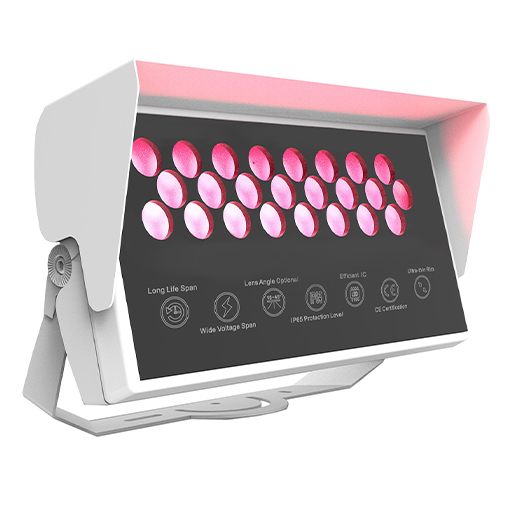
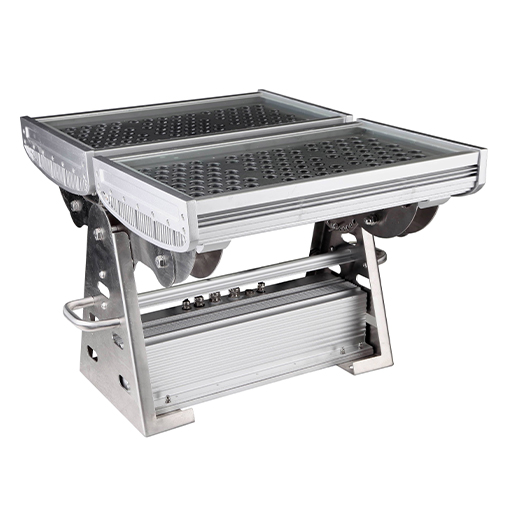
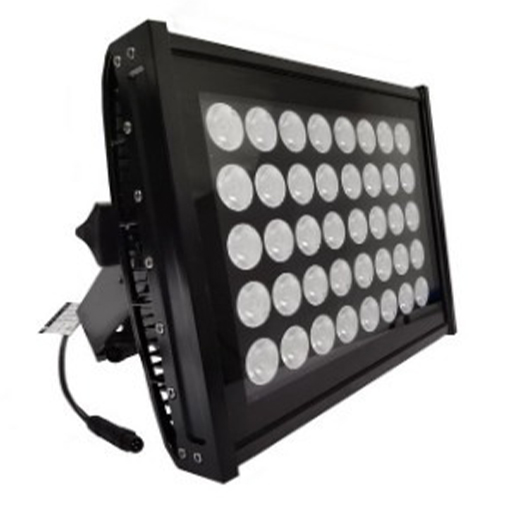
LED wall washers (18W–150W) are the primary fixture for bridge deck fascias, pier columns and structural surfaces requiring uniform surface illumination. Key selection parameters:
- Height of the surface to illuminate — determines wattage and beam angle required
- Mounting position and distance — affects beam angle selection
- Whether dynamic colour is required — RGBW vs static white
Linear Lights — for Structural Outlines and Cable Stays
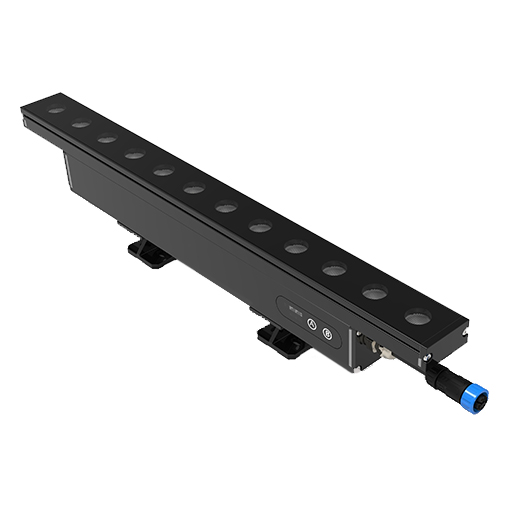
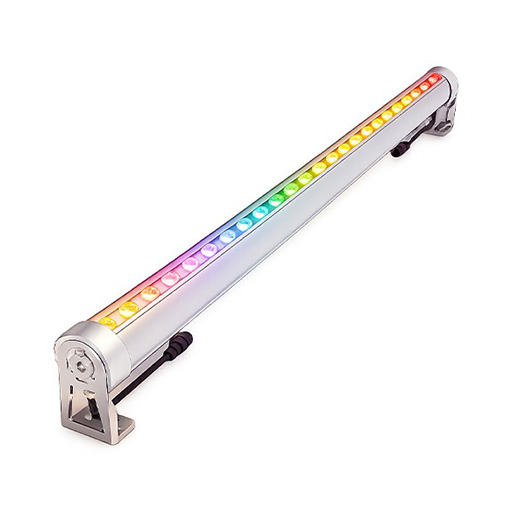
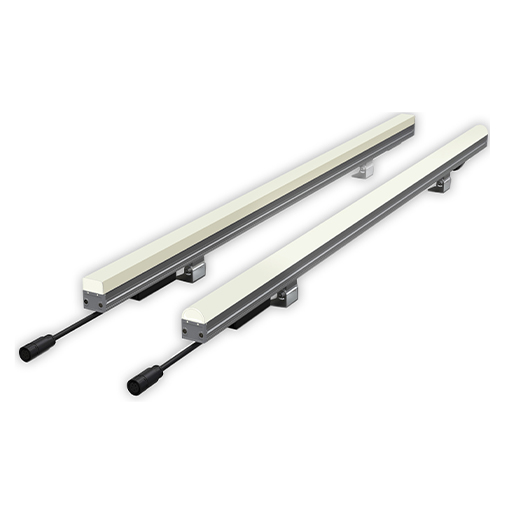
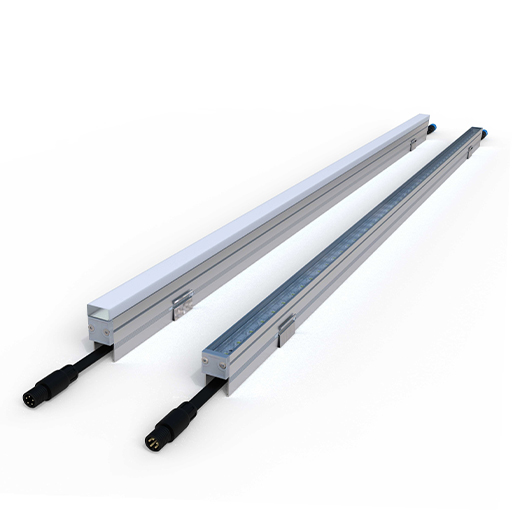
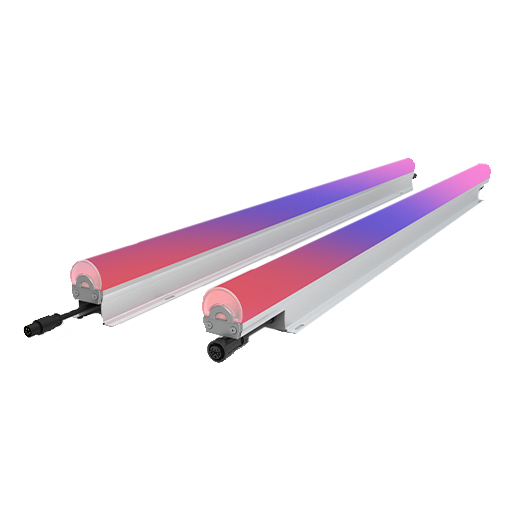
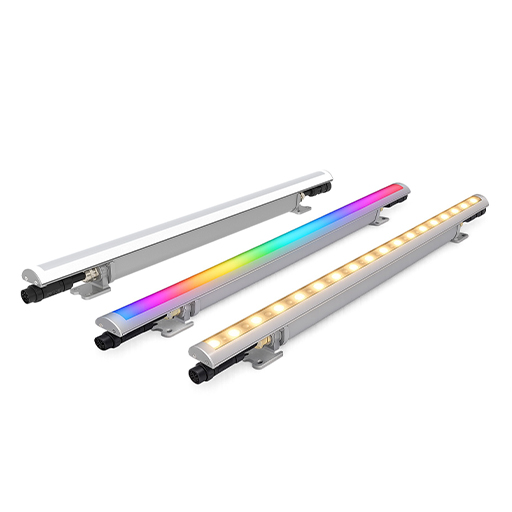
LED linear lights (20W–40W) are used to define the silhouette of bridge structures — handrails, cable stay outlines, truss chords and arch ribs. They create the distinctive "outlined" night appearance of landmark bridges and are typically RGBW for dynamic bridge installations.
High-Power Spotlights — for Arch and Tower Uplighting
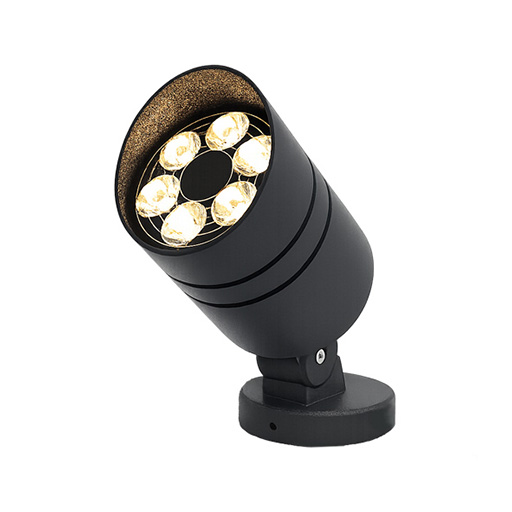
For large bridge pylons, arch structures and tower elements requiring uplighting from significant throw distances, high-power spotlights (170W–620W) with narrow beam angles (8°–20°) are required. Precise aiming is critical — a 2° error at 30m throw distance produces significant displacement on the structure.
Fixture Spacing — Wall Washers on Bridge Fascias
Wall washer spacing on a bridge fascia determines uniformity. The standard engineering target is a uniformity ratio (Emin/Emin) of 0.4 or higher, meaning the darkest point is at least 40% as bright as the average illuminance. This target is consistent with CJJ 45-2015 (Urban Road Lighting Design Standard), which specifies a minimum Emin/Eavg of 0.4 for primary roads and 0.35 for secondary roads — the same threshold applies when barrier-height fixtures replace conventional road lighting on urban bridges. Lower uniformity (below 0.3) creates visible dark patches between fixtures that are particularly obvious on long, smooth bridge fascias.
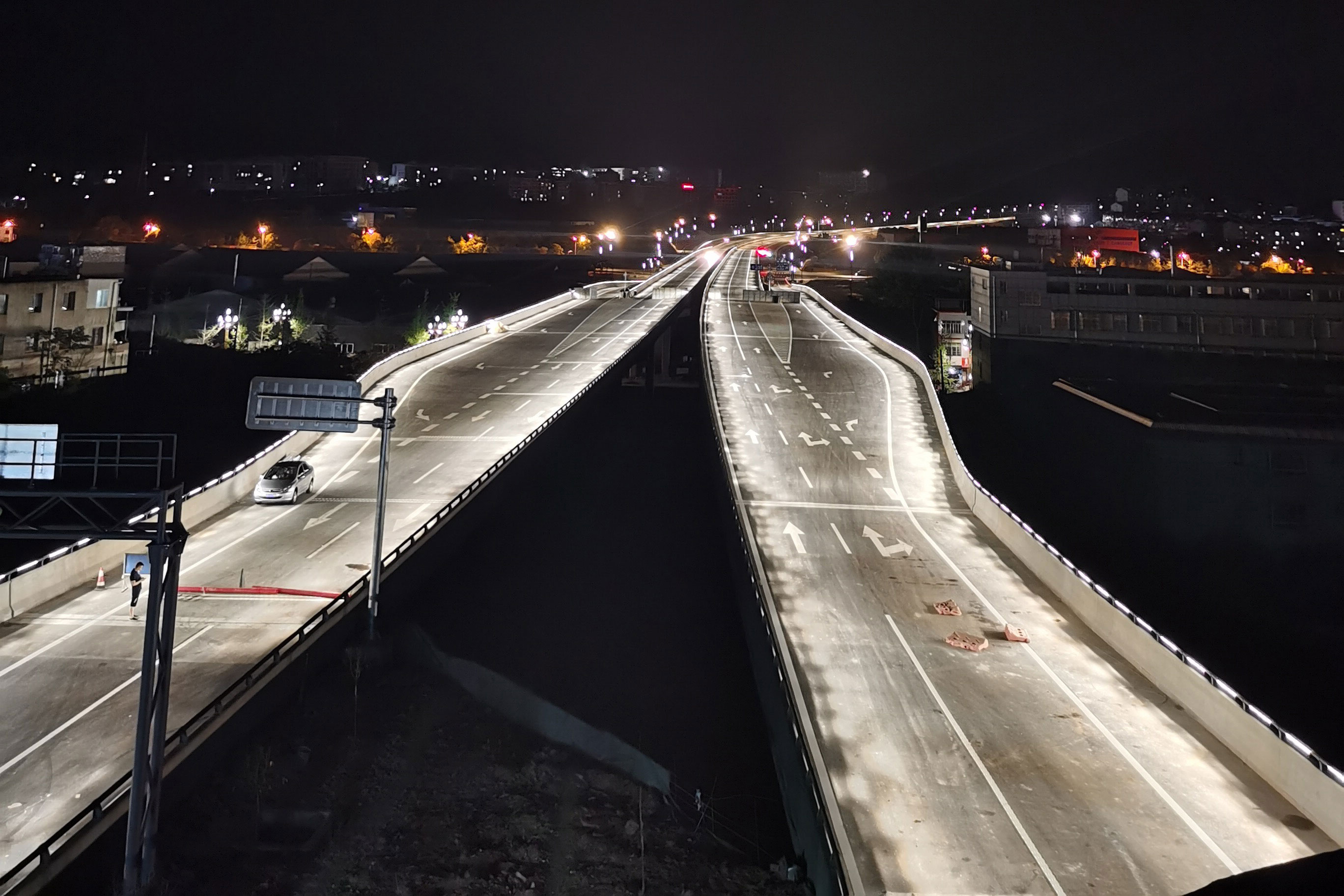
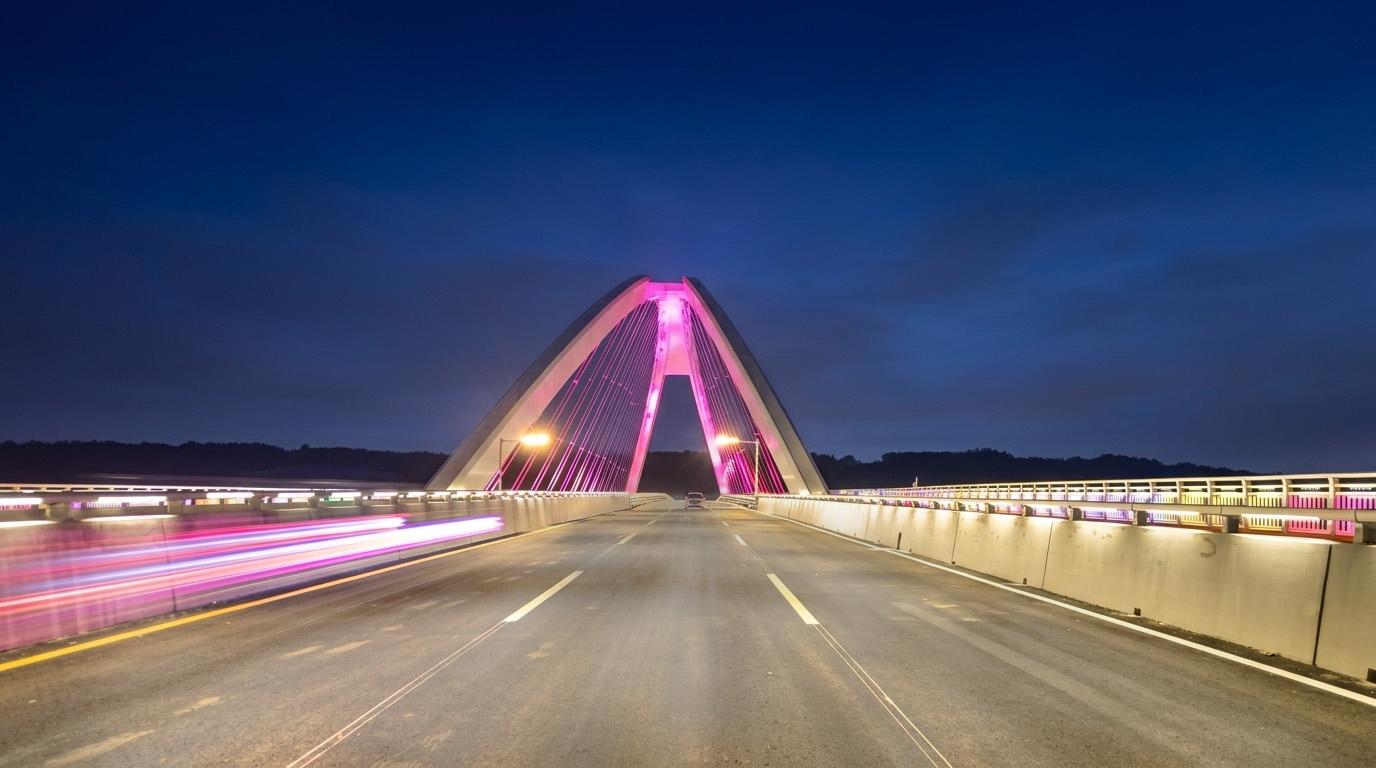
For bridge barrier lighting replacing high-mast road lighting: the LWW-GRB-W70/W55 series used on the Fujiang Bridge achieves a 93° horizontal beam at 1.4m mounting height, covering two full 3.5m carriageway lanes per unit. Far-lane edge illuminance: 33.2 lx confirmed by IES photometric data (Guangdong Tairan Industrial test lab, November 2024). This validates barrier-height placement as a functional alternative to high-mast poles on road bridges where anti-glare control is the primary constraint.
As a starting guide:
- 38W · 30° beam · 0.8m mounting distance → spacing 1.5–2.5m
- 80W · 20° beam · 1.5m mounting distance → spacing 2.5–4m
- 150W · 10° beam · 2m mounting distance → spacing 3–5m
Always verify spacing using DIALux or AGi32 with the manufacturer's IES photometric file before finalising the fixture schedule. TPK provides IES files for all wall washer, linear light and spotlight series. Photometric simulation support is included at no charge with project inquiries.
Note on barrier-height mounting: The starting-guide figures above apply to conventional fascia mounting. For barrier-height installations (1.4m from road surface), beam geometry changes significantly. The LWW-GRB-W55/W70 series achieves a 12–13° vertical half-beam angle with 92–93° horizontal coverage at this height — equivalent to two standard 3.5m traffic lanes per fixture, confirmed by IES testing. Anti-glare optics are non-negotiable at this mounting height: a standard fixture without cutoff optics will project directly into the driver's eye line.
Surge Protection — Critical for Bridge Installations
Bridges are exposed to elevated lightning strike risk: they are elevated above the surrounding terrain, structurally connected to earth via large metal masses, and often located near water which attracts discharge. LED drivers without surge protection fail permanently after a strike, and replacing fixtures on a bridge is costly and disruptive.
Specify LED drivers with built-in surge protection rated to a minimum of 10kV line-to-ground and 6kV line-to-line per IEC 61000-4-5. Additionally, install external surge protection devices (SPDs) at the distribution board. On long bridges, SPDs at the midpoint of the run are also recommended.
Pre-Installation Checklist
Case References
Location: Mianyang Science and Technology City, Sichuan, China
Client: China Railway 18th Bureau (中铁十八局)
Completion: May 2025
Products: LWW-GRB-W70 / LWW-GRB-W55 series — 3 custom specifications for D108mm and D75mm barrier pipes
Total barrier fixtures: 2,637 units
Photometric data (IES test, Guangdong Tairan Industrial, Nov 2024):
Vertical beam angle (50% Imax): 12–13° — controls driver glare at 1.4m eye level
Horizontal beam angle (50% Imax): 92–93° — covers two full 3.5m carriageway lanes
Far-lane edge illuminance: 33.2 lx at maximum coverage distance
Upward light emission: 0.0% — full cutoff, zero sky glow
Luminous efficacy: 93.74–104.74 lm/W across three specifications
Engineering challenges resolved:
— Driver glare at 1.4m: new-tooled lens + stamped metal anti-glare shroud + blackout treatment → glare reduced 30%
— Three pipe diameters, three installation geometries → three custom specifications developed in one project cycle
— 1km DMX signal run (standard limit 300m) → multi-stage repeater architecture, zero scene dropout
— Load-bearing arch and pier structures: no drilling permitted → welded angle-iron secondary mounting throughout
— Bayer 2807 PC lens: >90% transmittance, <5% yellowing over 5 years; IK10 impact rating; annual lumen depreciation <5%
Location: Volgograd, Russia · Volga River
Temperature range: −40°C to +38°C
Products: LWW-ROWS-W150 wall washers, DMX512 control
Challenge: Cold start at −40°C, multi-year operation without maintenance access
Result: Continuous operation through multiple severe Russian winters since installation
Engineering FAQ
On long cable runs: standard DMX512 signal degrades significantly beyond 300m. On the Fujiang Bridge in Mianyang, the DMX control platform is located approximately 1km from the furthest fixtures. The solution: a multi-stage signal extension and repeater architecture with amplified segments, maintaining full scene integrity across all 2,637 barrier fixtures and 1,292 arch wall washers with zero dropout. If your bridge exceeds 300m, plan the signal distribution infrastructure before specifying products.
Standard catalogue barrier fixtures without anti-glare optics will fail this application — the fixture sits at driver eye level and will cause disabling glare. A purpose-designed anti-glare optical system (new-tooled lens + metal shroud + blackout treatment) is required. Verify with DIALux using the actual IES file before specifying.